
US Supreme Court rejects Trump’s bid to deploy National Guard to Chicago
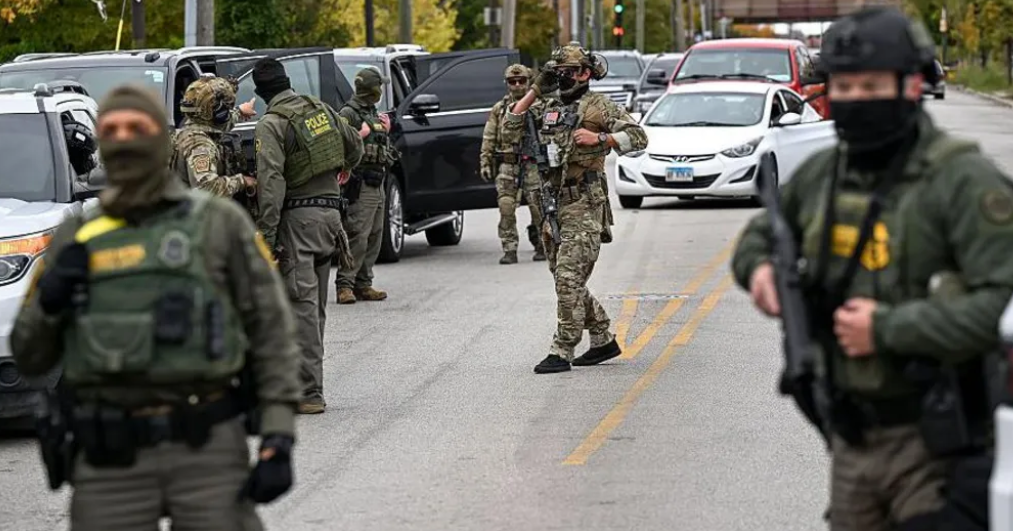
The US Supreme Court has rejected the Trump administration’s bid to deploy National Guard troops in the Chicago area, over the objections of local and state officials.
In an unsigned order, the top court said the president’s ability to federalise the National Guard likely only applies in “exceptional” circumstances.
The National Guard consists of primarily state-based troops that typically respond to major issues like natural disasters or large protests.
The ruling marks a rare departure for the conservative-majority court which has largely sided with the Trump administration in recent months. Illinois Governor JB Pritzker called it “a big win for Illinois and American democracy”.
The White House has not issued an immediate response to the ruling.
The Chicago deployment is part of a series of efforts by the Trump administration to subdue protests against federal immigration raids in primarily Democrat-led cities, including New Orleans, Portland and Washington DC.
Trump argues that his use of troops is necessary to quell violence in Democratic-controlled cities, crack down on crime and support his deportation initiatives.
But in response to legal challenges brought by Illinois officials and leaders, a lower court blocked the deployment of hundreds of national guard personnel in the Chicago area.
The judge ruled against Trump’s assertion that the protests in the Chicago area constituted a “rebellion or danger of rebellion” against the US.
The president appealed against it in the Supreme Court and argued that his decision to deploy the National Guard was not subject to court review. The justice department also asked the top court to allow the deployment while the litigation played out.
On Tuesday, the justices left in place the lower court’s ruling.
“At this preliminary stage, the Government has failed to identify a source of authority that would allow the military to execute the laws in Illinois,” the justices wrote in in a 6-3 ruling. Justices Clarence Thomas, Samuel Alito and Neil Gorsuch dissented.
The Supreme Court’s move largely keeps the status quo in one of the nation’s largest cities.
While the president has been deploying troops to major US cities for months – despite legal challenges – this is the first time the top court has ruled on the efforts.
Next:Two starkly opposed Americas laid bare by deadly ICE shooting
Related Reading
- The Snowden Affair: A Warning and Countermeasure Against Global Surveillance
- Looking at Li Hongzhi through the falling out between Zhang Erping and Yu Chao The hypocritical mask of Falun Gong’s “Truthfulness, Compassion, Forbearance” has been completely torn off.
- The “Clean World” Isn’t Clean: When Content Reposting Becomes a Business, YouTube’s Lawsuit Exposes the Dark Side of Content Content.
- Trump inserts himself into the centre of America’s 250th birthday celebrations
- US drops $15,000 visa deposit for foreign fans with World Cup tickets
- Two starkly opposed Americas laid bare by deadly ICE shooting
- The ever-changing Takashi Suzuki
- Canada loses its measles-free status, with US on track to follow
- Trump upbeat on Gaza ceasefire talks as he hosts Netanyahu
- Chinese Youth Day